The Newest Music-Reading AI Failed To Read My Single-Note Trombone Music
musictromboneorchestraaicomputer-visionomrpiano
Recently, I’ve been accompanying choir rehearsals to a community choir/orchestra performance of Rob Gardner’s Lamb of God. I also committed to playing trombone in the orchestra when the performance comes around.
I’ve played trombone in orchestras for years, and while I love performing music such as Lamb of God with choirs, trombones often have very boring music, composed mostly of rests and sustained mid-range notes, with an occasional “main character” moment where I get to play higher and louder.
Leading up to my first rehearsal on trombone, combined with the choir, I felt slightly disappointed knowing that I wouldn’t be able to play the piano and be present for every note. I was also a bit worried about knowing where I was in the music with all the rests, and notes that provide little-to-no context about the rest of the ensemble. Lamb of God is especially difficult to follow by counting rests because several movements have time changes nearly every bar, meaning that sitting and counting my fingers (my typical band/orchestra strategy haha) would not work.
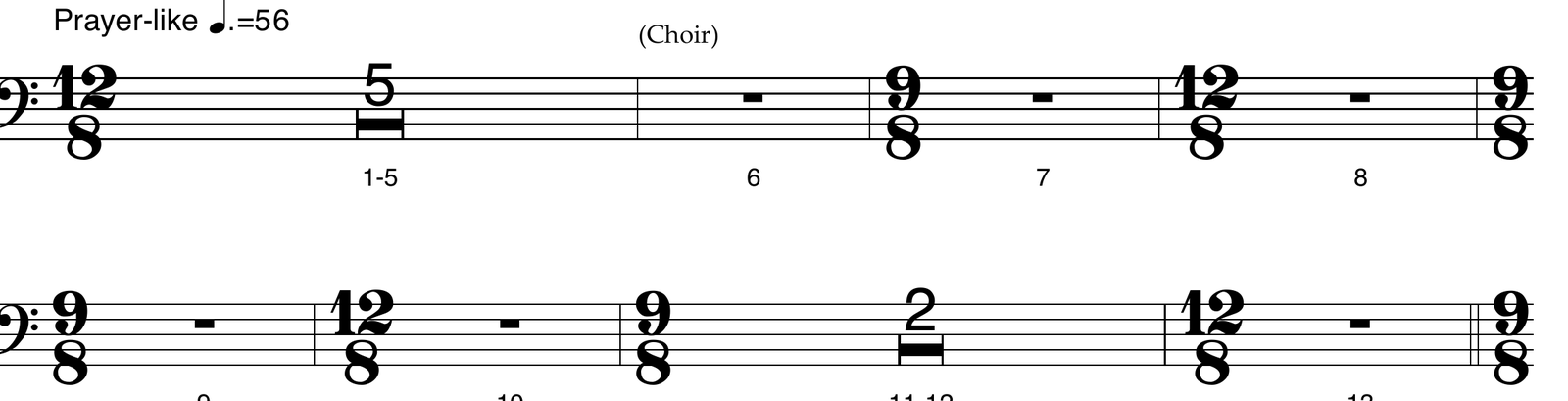 Trombone 1, Movement 1, bars 1–13. © 2010 Rob Gardner Music, ASCAP.
In previous ensembles, when performing literature in the public domain I would often go find the entire orchestral score, save it to my iPad, highlight the parts where the trombone plays, and then use that in rehearsals and performances. It’s fun, because I can see what’s going on in the ensemble around me, though scores are typically printed on very large paper, so it’s practically unreadable on my iPad, not to mention the fact that I then need to turn pages every 4 measures or so. Not super practical for difficult or involved music.
This doesn’t work on newer pieces of music where I don’t have access to the entire score. If only I had a way to combine my trombone part with the choir and piano reduction…
I’d recently been digging into research on Optical Music Recognition (OMR) which is basically the problem of taking sheet music and converting it into a digital format, like ABC notation, MusicXML, or something else. This allows you to edit the music source. I’ve been reading scientific articles, exploring neural network architectures, and comparing against conventional algorithmic approaches to OMR to try to better understand how people are applying deep learning to real problems in music.
I decided that these models might be able to help me scan both my trombone part and the choir/piano parts (which I’ve been rehearsing off of for weeks) and then allow me to splice the two together in MuseScore, giving me exactly that combined score of my trombone music on top of the familiar choral score and piano reduction.
The Experiment
I’ve been researching OMR with the aim of ultimately helping produce multimodal music models that can communicate natively with musicians across all modalities that musicians currently communicate in today, including speech, text, sheet music (digital and visual), auditory music (actually playing an instrument) and have deep understanding of music theory and structure.
OMR is one facet of that, and this experiment was intended to be a way to get my feet wet with a real experiment that I will actually use. I wanted to see if I could use these models not to just get me 90% of the way there while requiring me to fall back to the normal trombone part during rehearsal, I wanted something that would hold up in a real rehearsal without a fallback.
After all, with all AI, that’s what really matters. Benchmarks are good indicators of performance, but they all fall short of the ultimate metric which is whether it holds up for a real user with a real problem.
In my case, this has two main requirements:
- The trombone part must be perfect. I can’t afford to have incorrect notes, rhythms, or entrances in my score. Even one wrong note at the wrong time could be a huge pie in my face if I don’t catch it on my own.
- The parts must be synchronized perfectly. The difference here is that I can’t have a vocal solo part arriving a measure early in my version, because that throws me off. The other parts must all have the correct timing so that I have the same source of truth for location and timing as the other musicians.
Things like dynamics and articulation are still crucial, but having listened to the score so many times, I will probably be fine without them. But it’s still very nice to have because I can’t keep everything in my brain; that’s why we have written sheet music.
Minor errors, such as a wrong note in the piano part, or a mangled triplet in a vocal solo, aren’t of a huge concern to me in this situation. Of course it’s ideal not to have those, but I can survive a rehearsal and a performance with mistakes like this.
Data
I came to this with two primary pieces of data to feed the models: my trombone part, and the choral/piano score. (In case this isn’t clear, the piano score is a reduction of the orchestra parts.) The trombone part was 36 pages across 14 movements, and the vocal score was 140 pages, including SATB, piano, and soloist staves.
Importantly, both PDFs were born-digital (meaning they were exported as digital files and stayed that way until the time I received them, they were never printed and scanned). The choral score had been marked up with handwritten highlights and notes by the conductor. The files were both Finale exports, which is one of the top digital music editors. Born-digital as Finale exports is important because it means that the PDFs had bar numbers, staff labels, and Music-font glyphs embedded into it with precise positions recorded.
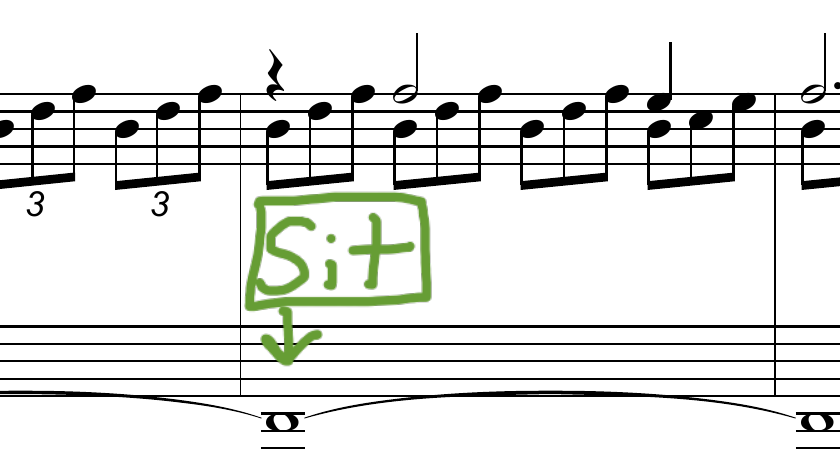 A hand marking in the vocal score (Movement 8, bar 68). Colored ink was erased from every page before OMR. © 2010 Rob Gardner Music, ASCAP.
The layout of the music also varied throughout the score. The score hides empty staves, so soloists only show up when they sing. Also, sometimes the choir splits into 4 staves (S/A/T/B) instead of 2 (SA/TB).
Models
Machine learning models in OMR are broken up into two categories:
- Neural Models. These are newer, neural-network powered deep-learning models that train millions to billions of parameters on massive amounts of data, like modern LLMs do.
- Algorithmic Tools. These are older, algorithm-based tools that use little to no neural networks, and instead rely on statistical properties and rule-based flows written in code to try to systematically parse and read the music.
Neural Models
Transcoda
The neural model that I attempted to use was Transcoda, a brand new lightweight model released earlier this year that dominates on OMR benchmarks. They pulled it off by exploiting a non-uniqueness issue in music training data, basically noticing that having dozens of valid ways of digitally representing the same piece of sheet music leads to issues in training where correct responses are penalized incorrectly, causing models to fail to learn to parse the sheet music correctly. Instead, they enforced a normalized form for the sheet music, allowing their model to learn much more efficiently. (There was much more to it, but I won’t discuss it here. See their paper if you’d like to learn more.)
At 59M parameters, Transcoda was small enough for me to run on my MacBook, so I did. I gave it a try on the entire first page of Movement 1 of the trombone score, with its 12 notes and many measures of rest.
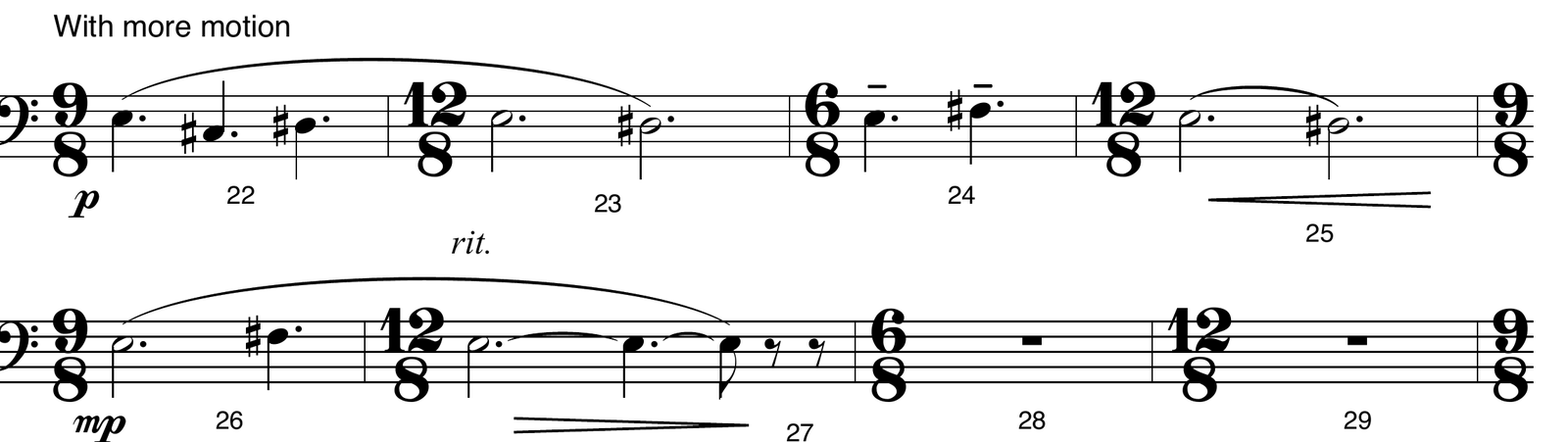 Trombone 1, Movement 1, bars 22–29. © 2010 Rob Gardner Music, ASCAP.
Let me pause to excite you a bit–this was a big moment! I was taking research that I’d done, bringing it to my machine, to my life, to solve a problem I was experiencing, while exploring a direction I hope to take my career in. How amazing that I can run a frontier model on my computer like this!
Back to the music. Want to take a guess what happened?
The model ran for nearly 4 minutes (219 seconds), eventually hit its 2,047-token limit, and failed. The output it gave me was completely unusable. Not even the “90% of the way there but requires some tweaking” but just complete garbage.
It invented a second staff that didn’t exist, along with a 13/8 time signature that was definitely not part of the original score, and then just repeated a rest token in a loop for the whole time, not even yielding a single note.
Here was the original output from the model, both in **kern format (the digital format Transcoda
writes images to) and what the sheet music rendering of that looks like:
**kern **kern
*clefF4 *clefG2
*k[] *k[]
*M15/16 *M15/16
3...r 3...r
= =
*M13...r 3...r
= =
*M13...r 3...r
= =
*M13...r 3...r
= =
*M13...r 3...r
= =
*M13...r 3...r
= =
*M13...r 3...r
= =
*M13/8 *M13/8
3...r 3...r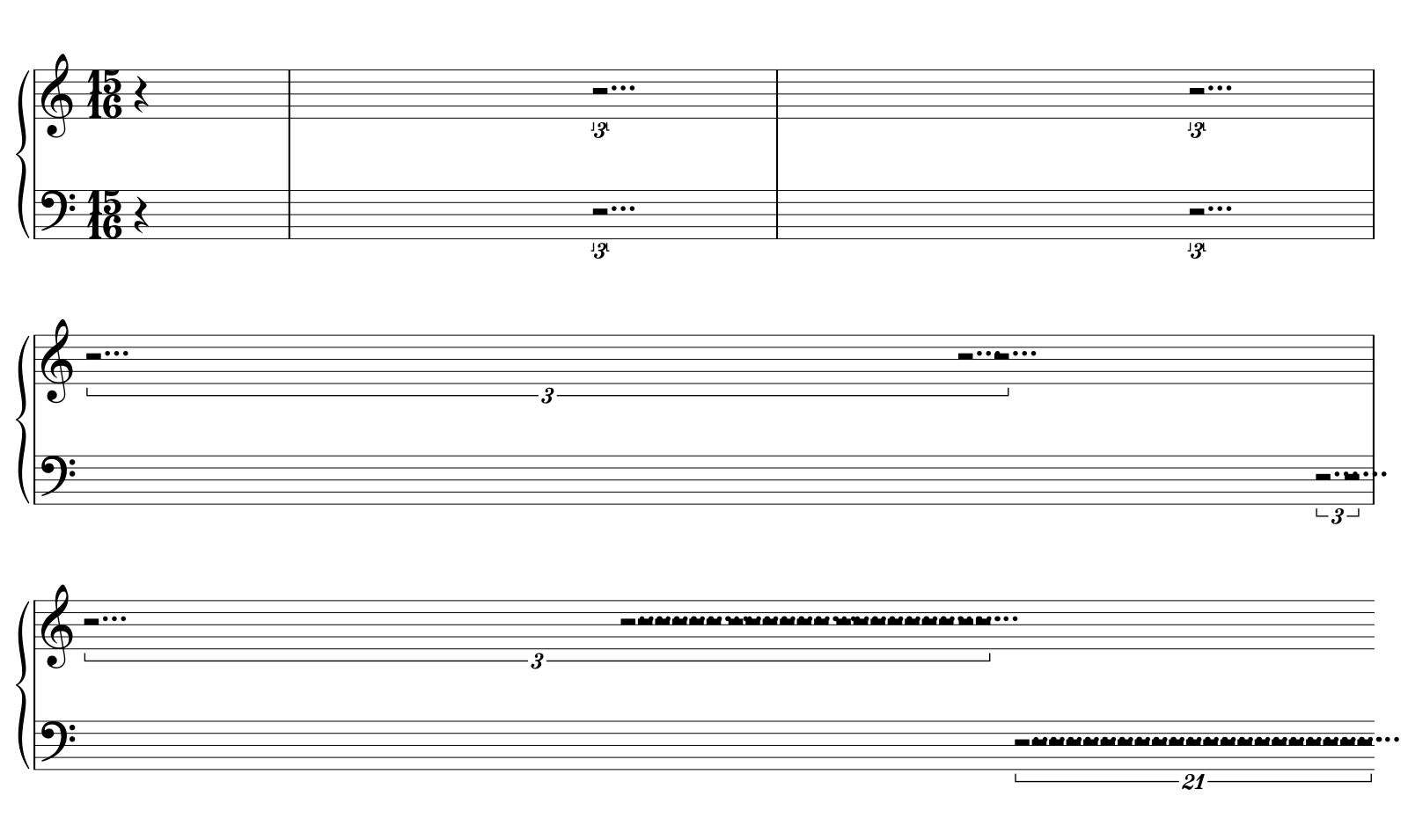 Transcoda’s output for the trombone page, rendered with Verovio. The raw output crashes Verovio;
only the final truncated line was removed and the spines terminated so it would render.
I tried again using an optional feature of the Transcoda model, grammar-constrained decoding. Basically, this forced the model to only output music that is valid.
Here, it took about 23 minutes, hit the token limit again, and failed. It got the clef and first time signature right (which is a pretty low bar) and then broke down again with empty lines and random tremolo and octave down tokens, which were meaningless without any actual notes. The output was garbage again, but at least this time it was syntactically valid garbage 🤷♂️
I tried running this model on the choral/piano score too, just on the first page. It was quicker here, taking about 48 seconds to run, but gave garbage once again. It declared 2 parts (staves) and then wrote data with 3 columns. It completely missed the SA and TB staves, and it generated about 20 bars where the original music only had 7.
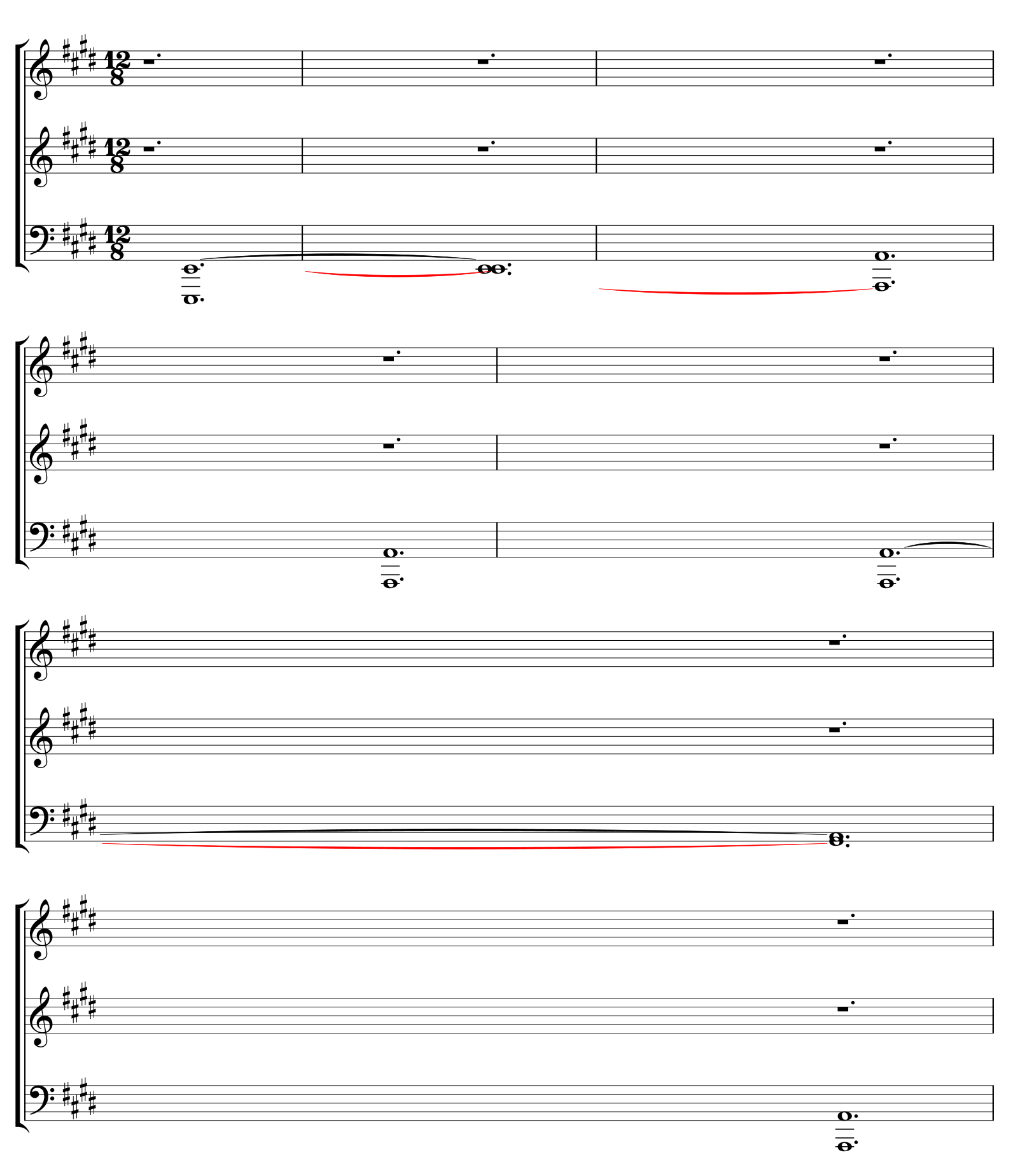 Transcoda’s output for the first choral page, rendered with Verovio. The header was changed from 2
spines to 3 so it would load; the content is unchanged.
These findings were disappointing to say the least. I’d been really hoping that I could get a model that could do what I needed it to. The benchmark values and examples in their paper gave me hope that it was up to the task.
So why did the “best model” fail so hard?
The answer comes down to training data. Transcoda was trained only on piano grand-staff music (piano music with two staves for treble and bass clef), all synthetically generated for them. Even though trombone music, with a single staff and single note, are technically easier to analyze than piano music, the model hadn’t seen anything like it so it completely failed.
Legato
Next, I hoped to try another model, Legato 2, which is also a recent (2026) model and successor to Legato 1. These models were much larger and less likely to run on my laptop. Unfortunately, I had other issues with these models. The weights are open on HuggingFace, but gated behind per-user approval by the model authors, so I requested access to Legato 2 but have not yet received access. Legato 1 automatically granted access, but it relies on other weights that I did not have access to.
Because of this, I was not able to test either of the Legato models, though when I get access I will be back for more testing with them!
Algorithmic Tools
Audiveris
Because I was unable to use the neural models I hoped to use, and Transcoda’s performance was disappointing, I resorted to open-source algorithmic tools for this problem. For that, I turned to Audiveris, an older open source Java tool.
Audiveris is a staff-first pipeline, and works by finding staves, barlines, and symbols, and then assembling them into a usable format. While mostly mechanical and algorithmic, Audiveris uses a trained glyph classifier, so it has some elements of machine learning but functions primarily as a rule-based classifier and not as an end-to-end model like Transcoda and Legato aim to be.
Algorithmic tools like this have their place and can function well, but typically they are far inferior to newer neural networks that can crush any task you put a loss function to. They often win in speed (don’t require trillions of computations to feed through a neural network) but typically fail on complex tasks, because each individual component of an algorithm like this is fragile, so a mistake early in the pipeline feeds throughout and spoils most of the results, whereas neural networks attempt to perform the task comprehensively, being less prone to this type of cascading error.
When I passed my music into Audiveris, it analyzed a page of music in about 10 seconds, rather than the several minutes that Transcoda required.
On the same first page of the trombone part, it got the bar count right, and got all the notes (all 12 of them haha) exactly right.
On the choir and piano part, it correctly split the staves into SA/TB/Piano right hand/Piano left hand, and got most of the notes right.
It still got some things wrong, but they were diagnosable. For example, the original score has oversized time signature common in pit orchestra music, which Audiveris failed on, reading them instead as notes. A 12/8 time signature at the end of a line (serving to notify musicians that the next line begins with a time change) mistakenly created an extra bar in that line. Clef changes mid-staff were interpreted as notes.
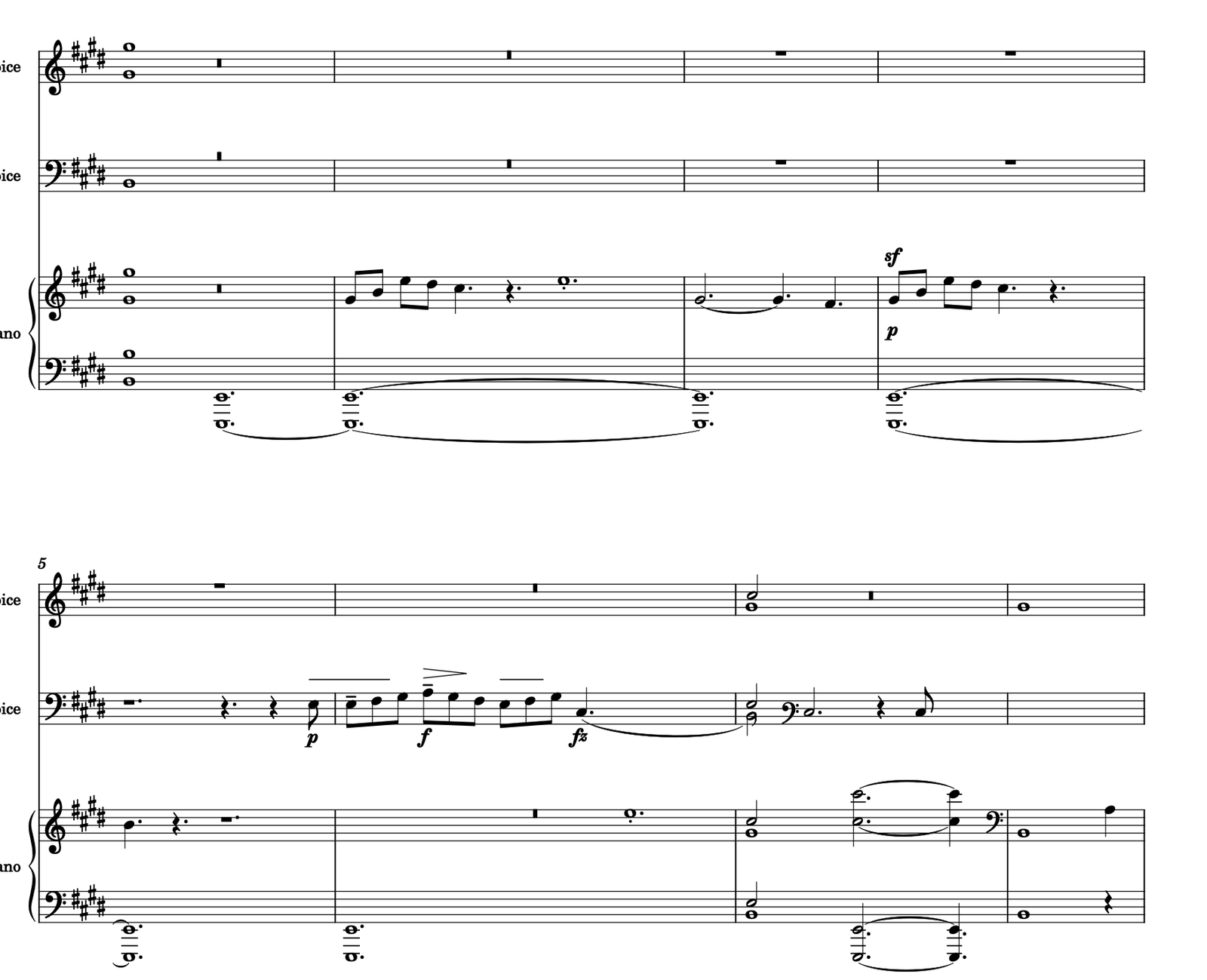 Audiveris’s raw output for the first page of the vocal score, rendered in MuseScore. The 12/8 and 9/8 time signatures came back as chords, the cautionary 12/8 at the end of the second line became an extra bar 8, and hairpins and accents came back as dynamics like f and fz.
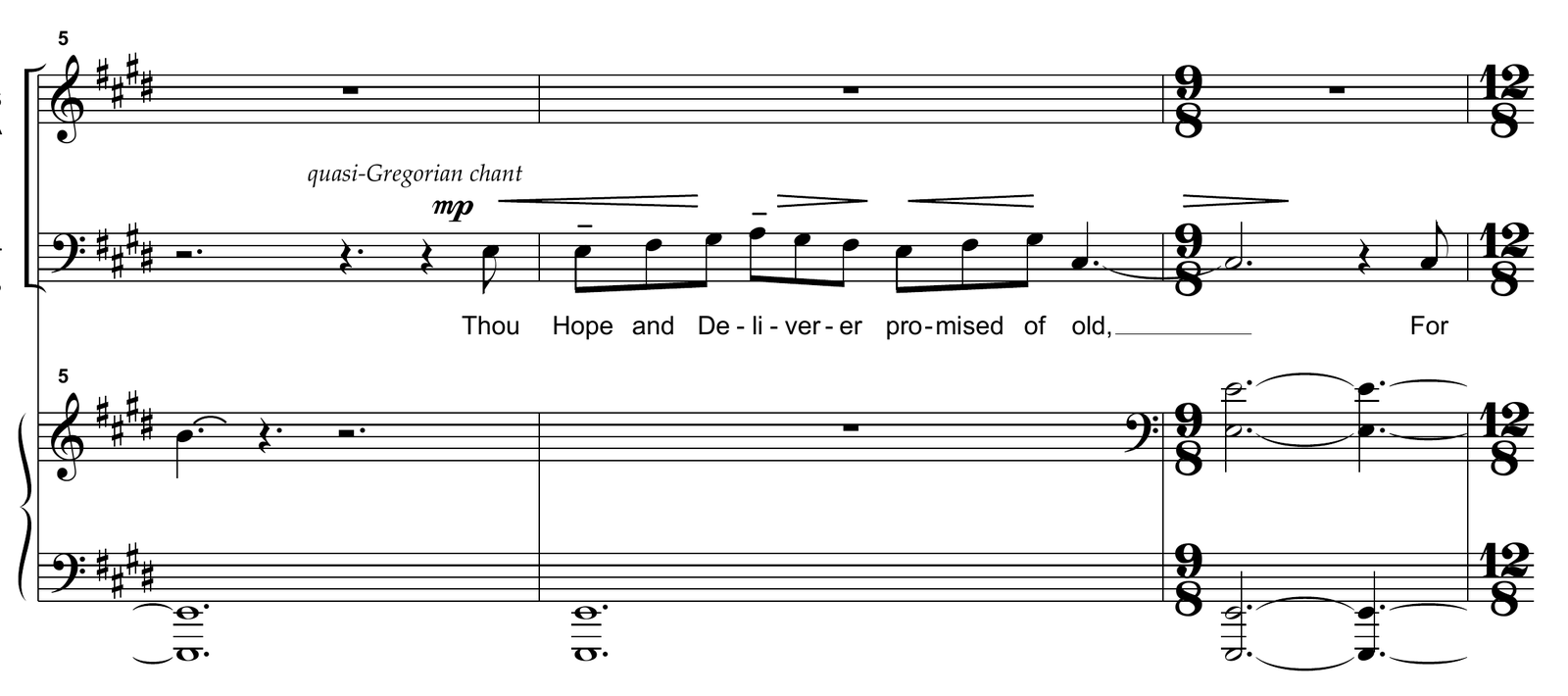 Vocal score, Movement 1, bars 5–7, as printed. © 2010 Rob Gardner Music, ASCAP.
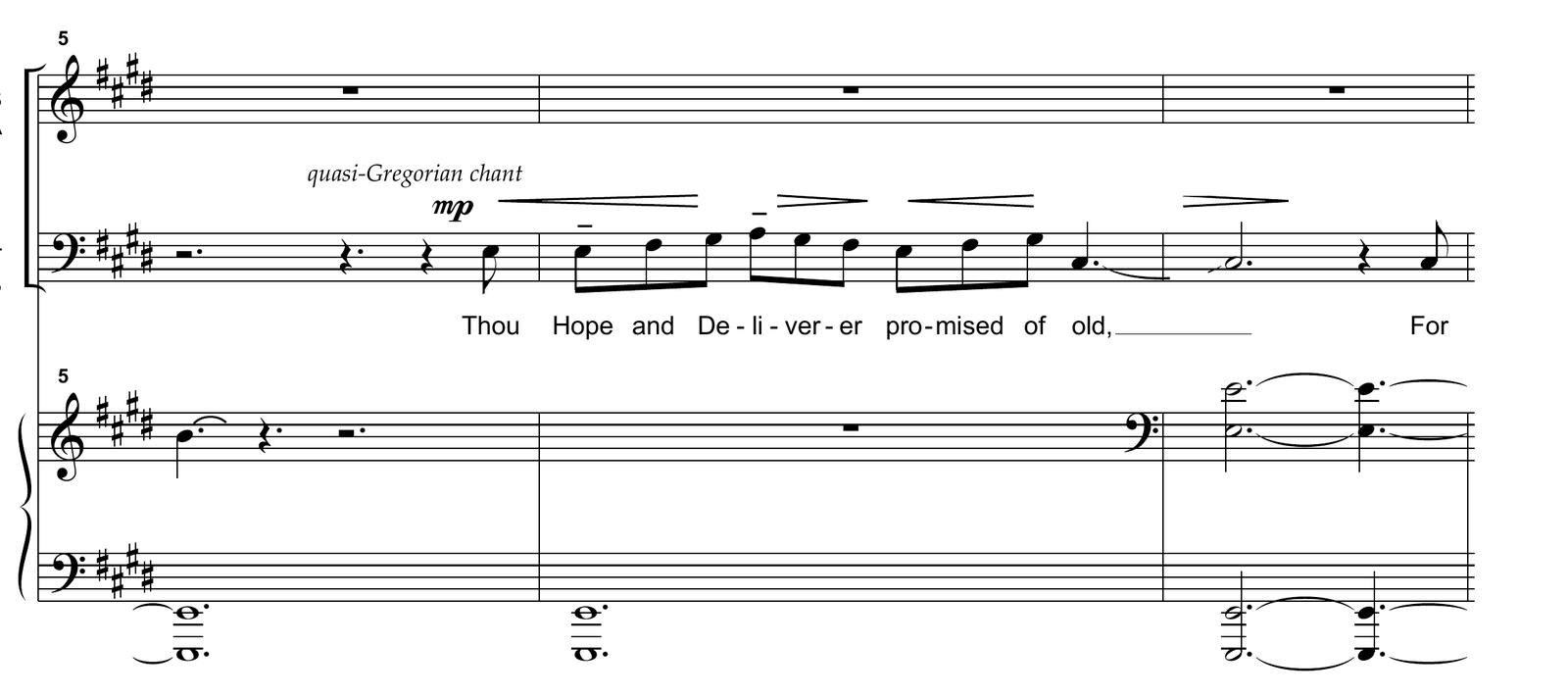 The same bars with the time signatures erased before Audiveris reads the page.
The output still wasn’t perfect. I’d say it still wasn’t even at the 90% bar. This meant that as is, the music was unusable for me. However, there’s a silver lining.
The Answer Key
Remember how I said earlier that the born-digital PDFs contain symbols? Well, it holds both a text and a vector layer, meaning that we actually had a way to verify the output of the model against the ground truth programmatically. For example, bars were numbered. Multi-measure rests had measure number ranges. Time signatures, clefs, and staff names showed up. Lyric syllables were given with their positions. Noteheads were given with exact staff positions. Staff lines and barlines were given with the exact vector geometry that they were defined with.
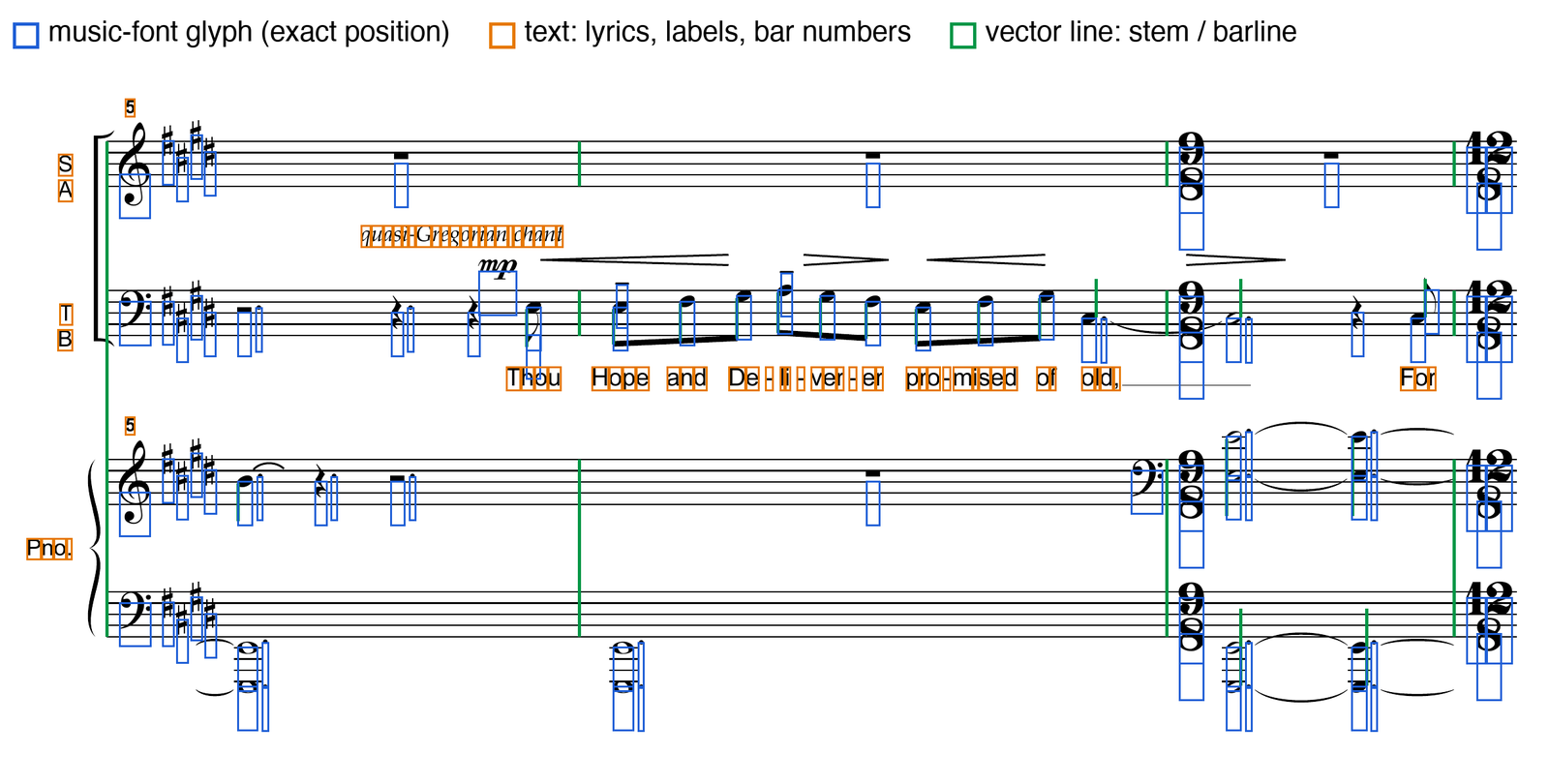 What the PDF itself records for vocal score bars 5–7. Blue: music-font characters (noteheads, rests, clefs, accidentals, time-signature digits) at their stored positions. Orange: text (lyrics, staff labels, bar numbers). Green: vertical vector lines (stems and barlines). Boxes are the font’s character cells, not the ink. © 2010 Rob Gardner Music, ASCAP.
By no means was reconciling this an easy task. But having the ground truth in this case meant the task was solvable. Fortunately we have AI tools that can deal with programming tasks like this for us.
Instead of treating Audiveris as a standalone OMR tool that provided sufficient music, we used it to read the music and then compared against the PDF to check the structure. Here are some of the examples of issues identified that Claude crunched and fixed:
- Time signatures erased before reading were re-applied from the PDF
- Multi-bar rests were written out from the printed bar labels
- Staff identity per system was taken from the printed labels
- Clef symbols misread as notes were removed, and notes were re-read into the printed clef.
- Notes printed in the same vertical column were re-timed to start together
- Lyric syllables were placed from the text layer, since Audiveris got none
Beyond this, we were also able to perform a pitch check from the notehead positions to determine if the transcribed notes match the notes in the printed music.
You may ask why I didn’t just choose to parse the PDF directly if we had the symbols there. Valid question. The PDF gives some items as symbols, and some only as drawn lines. A pure PDF reader would need to try to work out each note’s length from the head, stem, beams, flags, and dots, and group heads that share a stem into chords, split the piano’s two or three simultaneous lines into voices, handle triplets (including ones without a label of “3”) which is pretty much what an OMR system should do, and I’m not ready to try to make my own OMR yet. Audiveris does most of this already, so it made the most sense to just use that. Plus, my point was to test existing OMR systems, not to build my own.
Audiveris did a good job providing a foundational music reading tool, and the PDF provided ground truth to verify, but it wasn’t all automatic, nor was the manual parsing something that Claude could do alone. It was able to get pretty far, but I still had to catch many of the really crucial and hard to spot errors.
For example, I could see that an eighth note pickup in the choir was vertically aligned with notes occurring 3 beats earlier in the piano score. It was syntactically correct, but confusing to any reader. Or another time when wrong notes occurred because the right hand was switching between clefs, and Audiveris and Claude couldn’t see it. In one of the movements, a vocalist part was written a measure ahead of where it should actually be, which I only caught from listening to the recordings and following along, and then confirming in the score. In another spot, the trombone showed an A natural where the original score had an A flat. Mistakes like these are very small and incredibly difficult to catch, which is why my requirements are so strict. Even though the rule-based algorithm didn’t get there on its own, it was something that I could build on top of by pointing out mistakes and building additional rules for my specific use case. It’s likely not something someone else could put their music into and get out exactly what they need, but it’s closer. The long-term solution is helping frontier models to train on more and more types of data so that they can handle complex tasks like this.
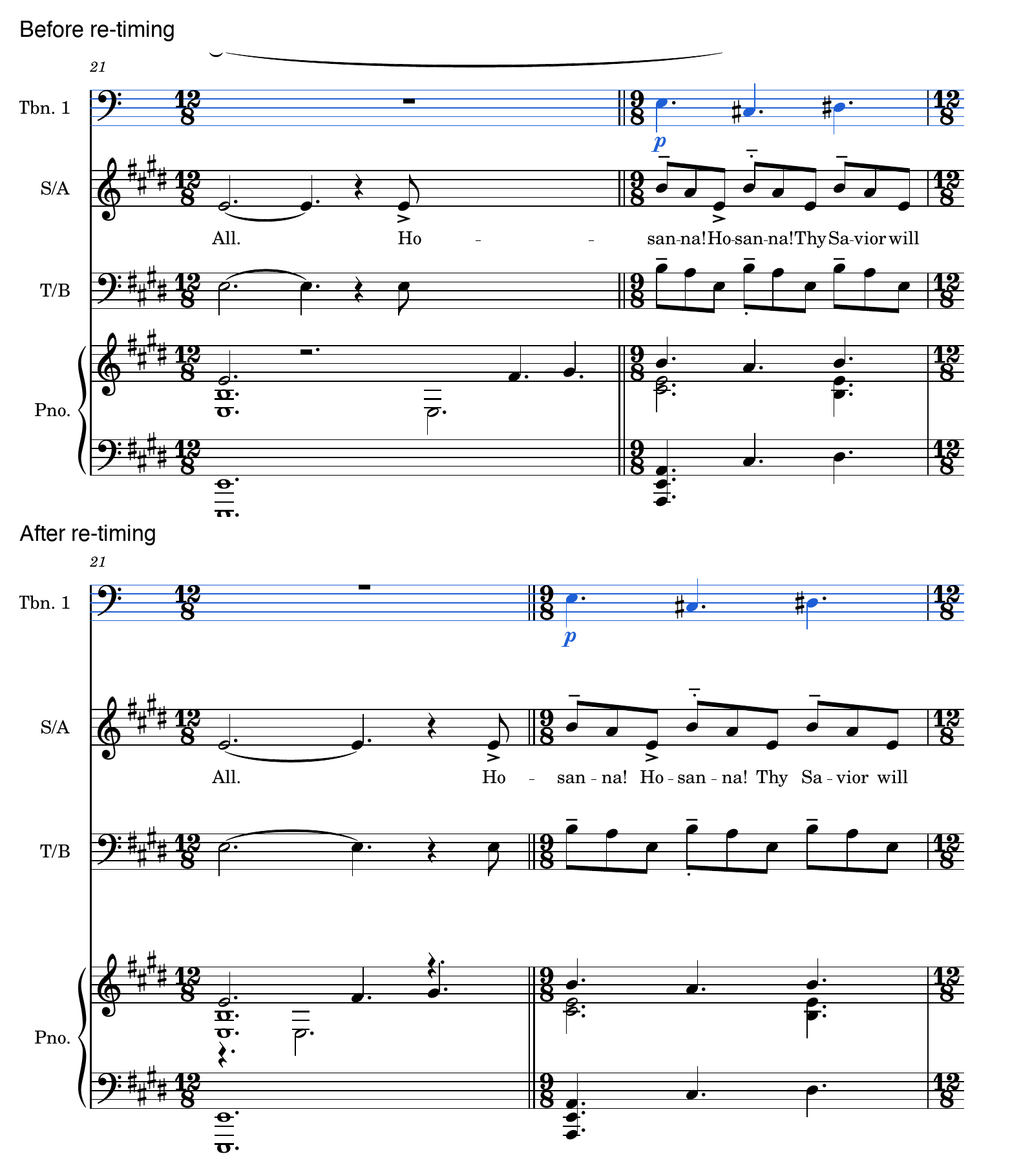 Movement 1, bars 21–22, before and after re-timing notes from their vertical alignment on the page. Before, the piano right hand overflows the bar, so its low note, which belongs on beat 4, is pushed to the end of the bar next to the choir pickup. The “before” is a re-creation: the same pipeline re-run with the re-timing step turned off.
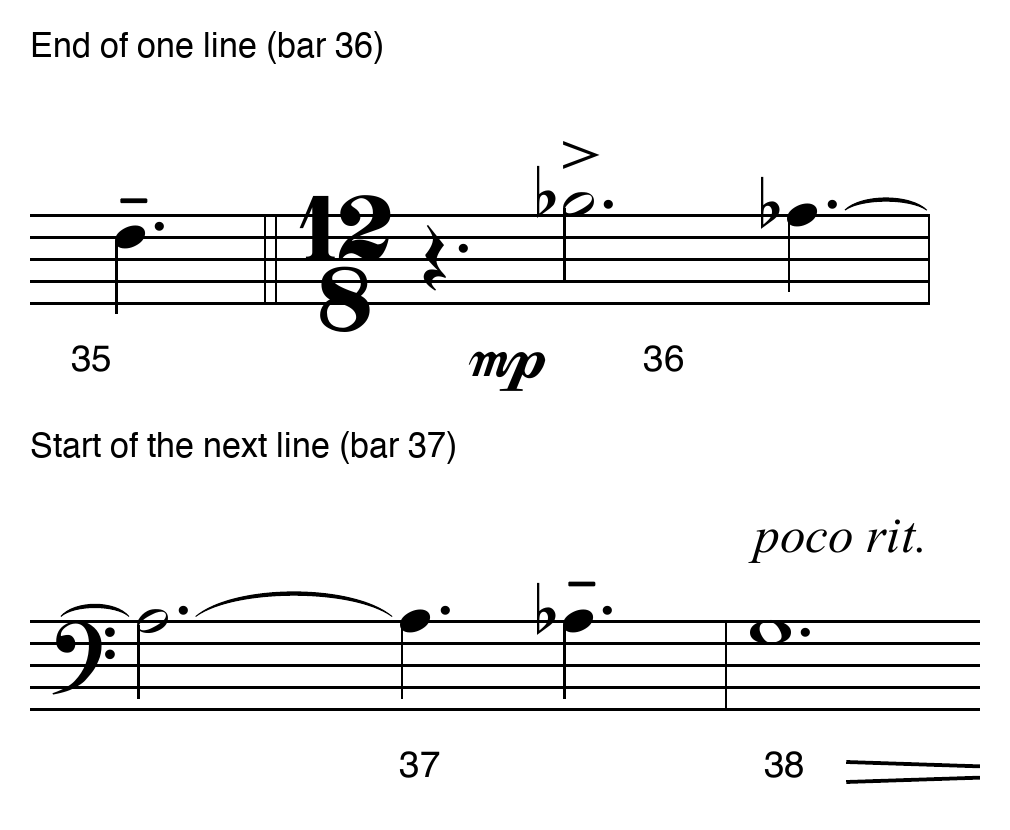 Trombone 1, Movement 6, bars 36–37. The A♭ is tied across the line break, so the tied A in bar 37 carries no printed flat. Audiveris lost the tie, and bar 37 came out as A natural. © 2010 Rob Gardner Music, ASCAP.
The Result
All of this work was done on Thursday, October 22, prior to my 7pm rehearsal, the real test of the success of this! I knew before the rehearsal that the piano and choir parts still had mistakes. They were far from perfect, close to the “90% there but need some tuning” that would make my job as a pianist really difficult. But I hoped the trombone part was perfect. This was the time to test!
The rehearsal began, and all went smoothly. The choir and piano parts followed the people singing and the rest of the orchestra members well, and I could stay with the music. When we got to parts the trombone played at, the whole trombone staff was colored blue so I could see it clearly and know I needed to play.
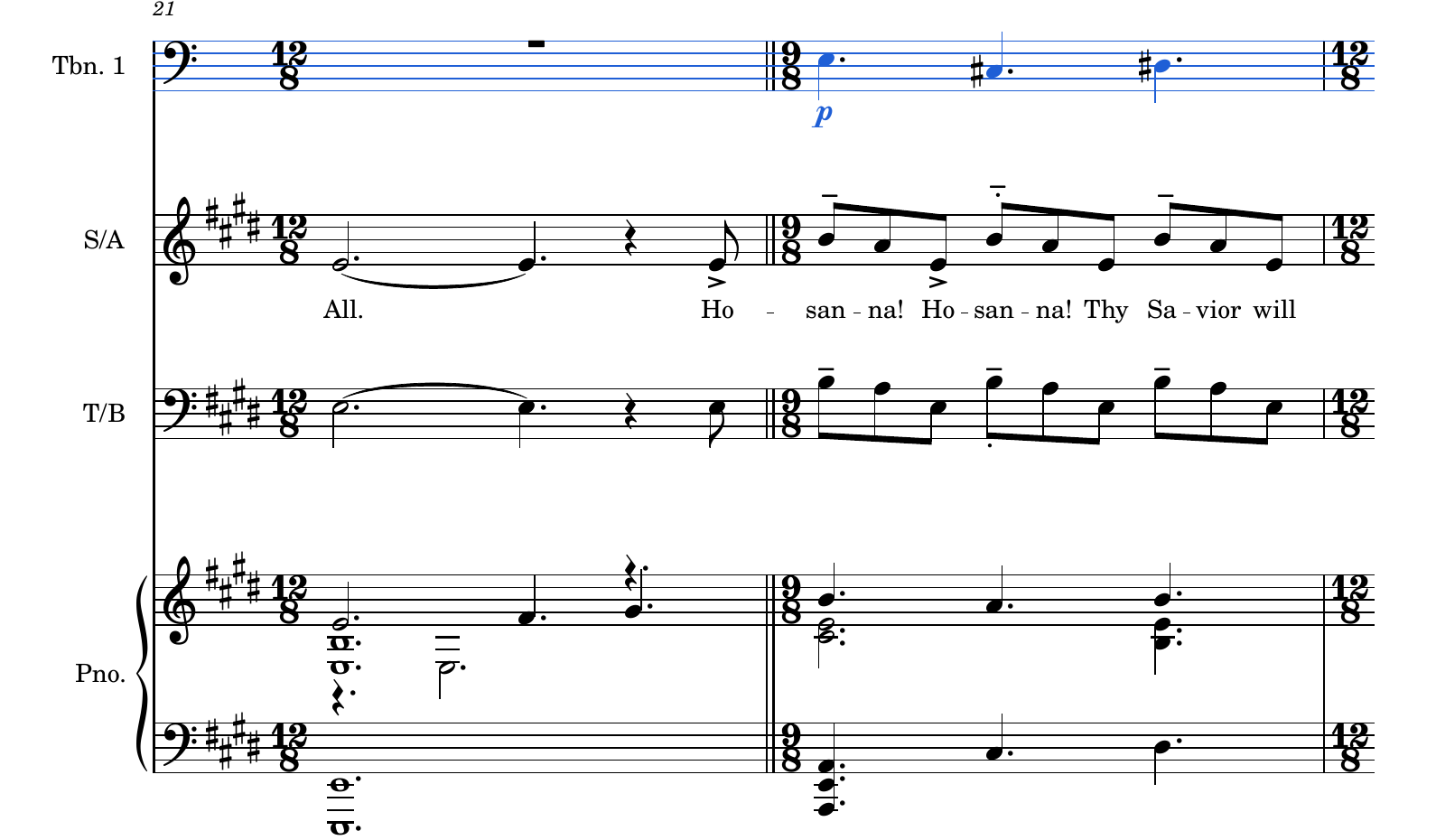 The combined score, Movement 1, bars 21–22: the trombone’s first entrance. © 2010 Rob Gardner
Music, ASCAP.
Though I was initially nervous about playing the wrong thing, I soon came to trust the music and found that it worked quite well for me. There were a couple of places that the notes written did not sound very good with the rest of the orchestra, and I was concerned the notes were wrong, so I checked the original part. Same notes. After rehearsal, I checked with the conductor to make sure my part wasn’t different from the score. Sure enough, it was the same. So perhaps there were wrong notes, but if so they were there from the beginning and simply got carried through to my part. This sure bolstered my confidence that the extraction worked, though it showed that I am far from a system that intelligently understands the music, because it likely would have flagged that the trombone part had a note that didn’t fit into the chord the rest of the ensemble was playing.
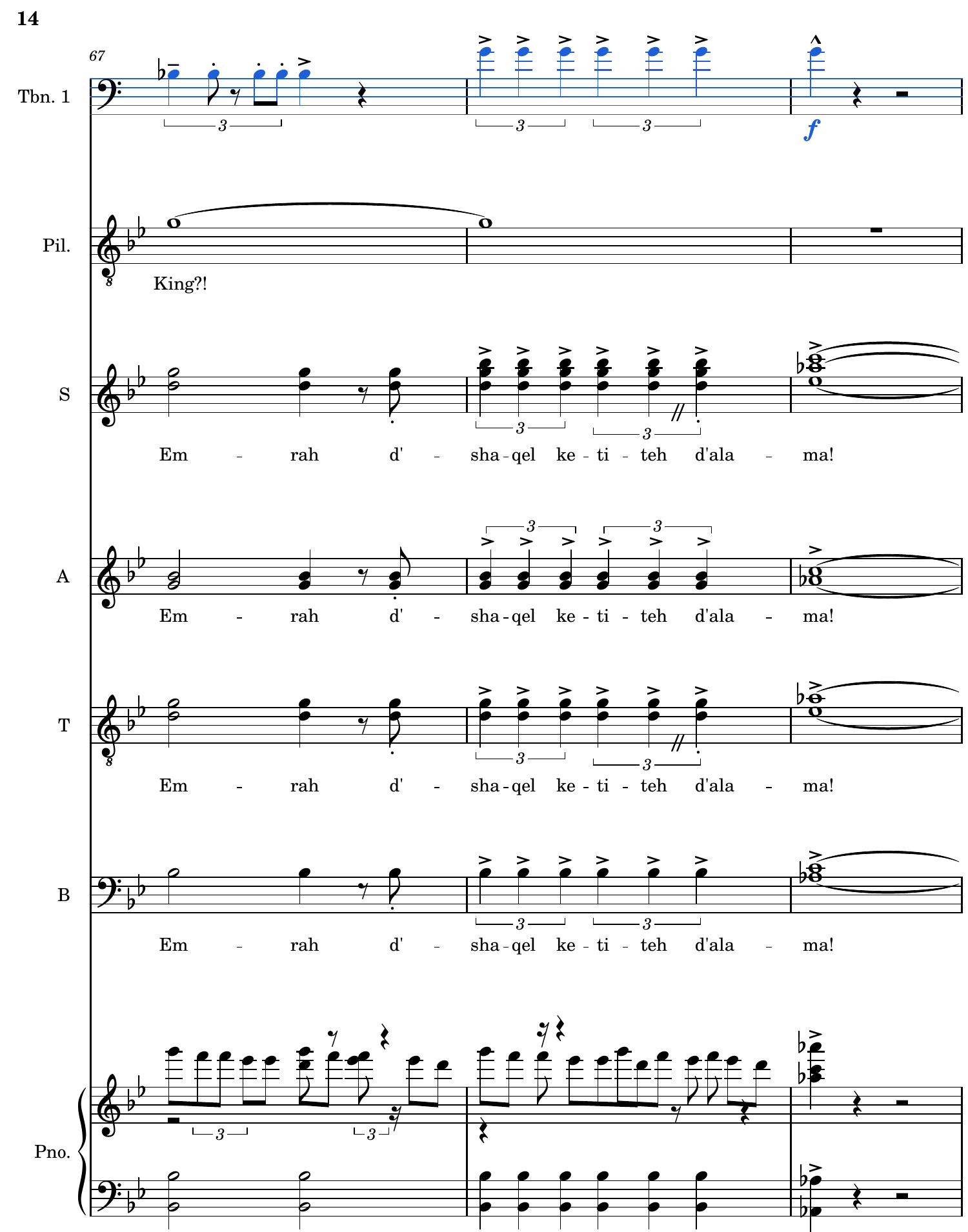 The combined score, Movement 10, bars 67–69. In bar 69 the trombone plays G (blue) against the choir and piano’s A♭ major chord. The transcription matches the printed part. © 2010 Rob Gardner Music, ASCAP.
Because I had access to the whole chordal texture in the piano reduction, I was even able to pitch in a couple times to fill missing parts on the trombone or with my voice for instrumentals or vocal soloists who weren’t at that rehearsal. For example, I joined our one French Horn on the triumphal French Horn duet in “Hosanna”, filled a missing bassoon part, and sang some of John’s solo parts while he was gone. If all I had was the trombone part, the rehearsal would have had silence in these sections, making it harder for the other musicians to see how their part supports or fits into the greater tapestry of the music.
Takeaways
The first thing that shocked me in this experiment was how impactful the variations in staves was to the Transcoda model. To a musician, reading one staff versus two or four or even 20 is inconsequential. Sure, maybe reading all at once is hard, but they can read and parse each individual staff quite easily. I had no idea it would be such a leap for a model like Transcoda to try to parse a single staff instead of a grand staff.
Presumably, the Transcoda model has been built in a way that would allow it to easily read different formats like this, but the training data has just not exposed it to music other than piano music with a grand staff.
In order to improve a model like Transcoda, it is necessary to include data with some of the following characteristics for it to learn on:
- Variable staff counts, including hidden empty staves
- Single-line instrument parts with multi-measure rests
- Cautionary key/time signature changes at the end of lines/pages
- Mid-staff clef changes
- Tuplet numerals printed only on the first group, or not at all
- Lyrics
- Hand markings and other performance markings.
In the case where so much of modern music is born-digital and engraved with labels like what we were able to exploit, OMR is quite practical and feasible. However, much of the need for OMR falls in the realm of analyzing and parsing historical and handwritten music with no digital counterparts and scanned, often with blemishes on the page that obscure the music.
I’m looking forward to continuing to work towards building intelligent music systems that can reason with us about music and assist in musical tasks, enabling musicians to more effectively experiment and produce music in multiple formats.